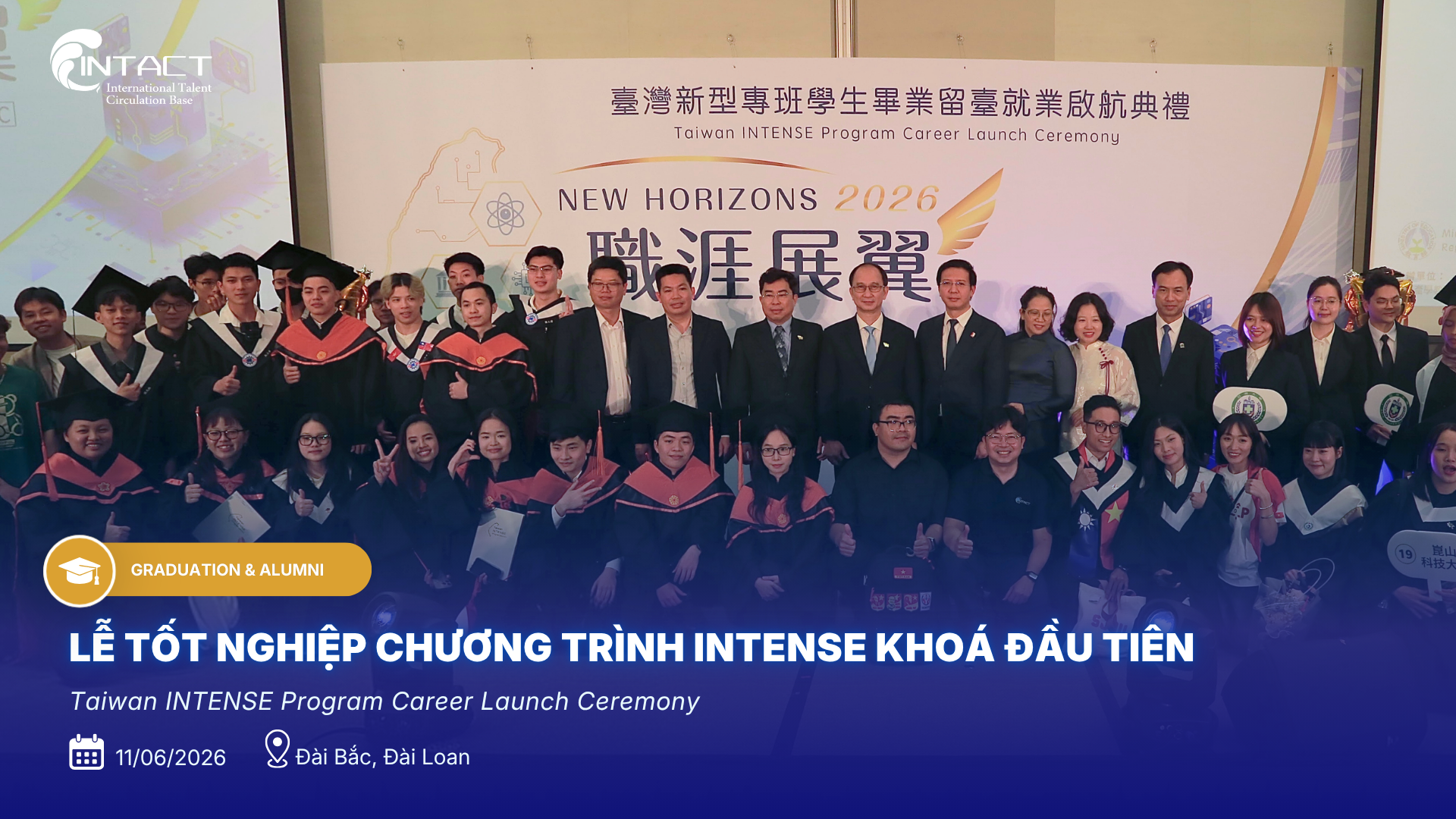
The inaugural cohort of the International Industrial Talents Education Special Program (INTENSE) has officially graduated, marking an important milestone in strengthening high-quality industrial talent development and educational collaboration between Vietnam and Taiwan.
A total of 79 Vietnamese students successfully completed their academic programs at universities across Taiwan. As the first graduating cohort of the INTENSE Program, they not only earned their academic qualifications at 16 Taiwanese universities but also joined 28 partner enterprises in Taiwan, demonstrating the program’s industry-integrated education model and its commitment to developing internationally competitive talent.
 Infographic: Overview of Vietnamese Graduates from the INTENSE Program | Class 1 – 2026
Profile of the First Graduating Cohort
1. STEM and Semiconductor Programs Continue to Dominate
Engineering and technology-related disciplines remained the primary fields of study among the 79 graduates.
| Field of Study | Female | Male |
|---|---|---|
| Finance | 5 | – |
| Semiconductor | 4 | 7 |
| STEM | 19 | 44 |
Together, the STEM and Semiconductor disciplines accounted for 93.7% of all graduates, reflecting the INTENSE Program’s strong focus on developing talent for high-tech industries.
Male students represented approximately 65% of graduates in engineering and technology-related disciplines, while all Finance graduates were female.
2. Distinct Academic Pathways and Languages of Instruction
The inaugural cohort demonstrated clear differences in academic pathways and languages of instruction.
| Program | Mandarin-taught | English-taught |
| Master’s Degree | 5 | 27 |
| Post-Baccalaureate / Second Bachelor’s Degree | 8 | – |
| Two-Year Bachelor’s Degree | 39 | – |
The Mandarin-taught Two-Year Bachelor’s Degree was the most popular pathway, accounting for 49.3% of all graduates.
Among Master’s programs, 84.4% were delivered in English, reflecting the program’s international orientation and the growing demand for globally competitive professionals.
3. Chinese Language Proficiency Meets Industry Expectations
In addition to academic and technical expertise, graduates also demonstrated strong Chinese language proficiency.
TOCFL Certification Distribution
| TOCFL Level | Number of Students |
| Not Yet Taken | 1 |
| TOCFL A2 | 21 |
| TOCFL B1 | 48 |
| TOCFL B2 | 7 |
| TOCFL C1 | 1 |
| TOCFL C2 | 1 |
Overall, 72.2% of graduates achieved TOCFL B1 or above, providing them with the language skills needed to communicate effectively and work in bilingual professional environments across Taiwan.
An Expanding Educational Network
1. Sixteen Taiwanese Universities Trained the First INTENSE Cohort
The 79 Vietnamese graduates completed their studies at 16 universities in Taiwan under the INTENSE Program.
| Taiwanese University | Students |
| Taiwan Steel University of Science and Technology (TSUST) | 33 |
| Minghsin University of Science and Technology (MUST) | 12 |
| Kun Shan University (KSU) | 7 |
| National Yang Ming Chiao Tung University (NYCU) | 7 |
| National Chung Hsing University (NCHU) | 4 |
| Asia University | 3 |
| National Chin-Yi University of Technology | 2 |
| National Formosa University | 2 |
| National United University | 2 |
| Chang Jung Christian University | 1 |
| Chung Yuan Christian University | 1 |
| Fu Jen Catholic University | 1 |
| Lunghwa University of Science and Technology | 1 |
| National Taiwan University (NTU) | 1 |
| Tatung University | 1 |
| Yuan Ze University | 1 |
The five leading host institutions—TSUST, MUST, KSU, NYCU, and NCHU—educated nearly 80% of the inaugural graduating cohort. Among them, TSUST welcomed the largest number of students, accounting for 33 graduates (41.8%) of the entire cohort
2. Students from 30 Feeder Institutions
Before joining the INTENSE Program, the graduates came from 30 educational institutions, including 28 institutions in Vietnam and 2 universities in Taiwan, demonstrating the program’s broad and diverse recruitment network.
| Feeder Institution | Students |
|---|---|
| Dai Nam University (DNU) | 14 |
| Hanoi Industrial Vocational College (HNIVC) | 9 |
| Hanoi Polytechnic College (HPC) | 6 |
| Hanoi University of Science and Technology (HUST) | 5 |
| National University of Civil Engineering (NUCE) | 4 |
| The University of Danang – University of Science and Technology (DUT) | 4 |
| VNU University of Science (HUS) | 3 |
| International University, Vietnam National University Ho Chi Minh City (HCMIU) | 3 |
| Hanoi International College (HIC) | 2 |
| Hanoi Pedagogical University 2 (HPU2) | 2 |
| Hanoi University of Mining and Geology (HUMG) | 2 |
| Ho Chi Minh City University of Technology and Education (HCMUTE) | 2 |
| Kun Shan University, Taiwan (KSU) | 2 |
| National Taiwan University (NTU) | 2 |
| VNU University of Engineering and Technology (UET) | 2 |
| VNU University of Economics and Law (UEL) | 2 |
| VNU University of Science, Ho Chi Minh City (HCMUS) | 2 |
| FPT University | 1 |
| Hanoi University of Business and Technology (HUBT) | 1 |
| Ho Chi Minh City University of Education (HCMUE) | 1 |
| Hung Yen University of Technology and Education (UTEHY) | 1 |
| National Economics University (NEU) | 1 |
| Thai Nguyen University (TNU) | 1 |
| Thu Dau Mot University (TDMU) | 1 |
| Ton Duc Thang University (TDTU) | 1 |
| University of Economics and Technology for Industries (UNETI) | 1 |
| University of Economics Ho Chi Minh City (UEH) | 1 |
| Hai Duong University (UHD) | 1 |
| Vietnam College of Industry and Trade (VCI) | 1 |
| Vinh Phuc Vocational College | 1 |
The feeder institutions range from vocational colleges to leading national universities, highlighting the diversity of academic backgrounds among INTENSE participants.
More than 50% of the inaugural graduates came from the program’s six largest feeder institutions: Dai Nam University (DNU), Hanoi Industrial Vocational College (HNIVC), Hanoi Polytechnic College (HPC), Hanoi University of Science and Technology (HUST), National University of Civil Engineering (NUCE), and The University of Danang – University of Science and Technology (DUT).
Geographically, over 70% of graduates originated from Northern Vietnam, primarily Hanoi and neighboring provinces, underscoring the region’s important role as a key talent source for the INTENSE Program.
Direct Integration into Taiwan’s Industrial Ecosystem
One of the defining features of the INTENSE Program is its industry-integrated education model, which combines academic study with practical industry engagement.
Upon graduation, all 79 students joined 28 partner enterprises across Taiwan, working in a wide range of strategic industries.
Employment Distribution by Industry
| Industry Sector | Students | Share | Representative Companies |
|---|---|---|---|
| Steel, Metallurgy & Electromechanical Engineering | 25 | 31.6% | Taiwan Steel New Retail, Yisheng Steel, Pei-Po Steel, Ching Shin Shin Steel, Taiwan Steel Machinery & Electrical |
| Precision Machinery, Manufacturing & Advanced Materials | 21 | 26.6% | Enliang Enterprise, Zuoxin Technology, Yingsheng, Yonghu Composite Materials, Dayi Machinery, Hexin Refrigeration |
| Semiconductors, Integrated Circuits & Optoelectronics | 15 | 19.0% | Micron Memory Taiwan, MIC (Enmao Technology), Global Lighting Technologies, Ya Hsin Technology, Kinsus, Keyi Technology, Phison Electronics |
| Software, Information Technology, AI & Automation | 9 | 11.4% | NewSoft Technology, Crown Asia Technology, Solomon Technology |
| Finance, Audit & Professional Services | 5 | 6.3% | Yuanta Securities, PwC, Crowe (Taiwan) CPAs |
| Textiles, Design & Green Industries | 4 | 5.1% | Tainan Enterprise, New Wide Enterprise, Lu Feng Enterprise, Orlean Design |
Notably, 31.6% of graduates joined companies within the Taiwan Steel Group (TSG).
When combined with graduates employed in the semiconductor, electronics, and digital technology sectors, more than 60% of the inaugural cohort is now working in Taiwan’s two most strategic industrial clusters. These outcomes highlight the close alignment between the INTENSE Program’s academic training and the workforce needs of Taiwan’s high-tech industries.
Building the Foundation for the INTENSE Alumni Community
The inaugural graduating class represents more than the completion of the first INTENSE cohort—it marks the beginning of the INTENSE Alumni Community.
Starting with these 79 pioneering graduates, the INTENSE Program continues to expand its collaborative network among universities, enterprises, and institutional partners across Vietnam and Taiwan.
Through this growing partnership, the program aims to cultivate a new generation of internationally competitive industrial professionals equipped with technical expertise, multilingual capabilities, and global experience to support the future development of key high-tech industries.
Take a look back at the memorable moments from the Taiwan INTENSE Program Career Launch Ceremony in the highlight video below.
CONTACT INFORMATION
INTACT Base Vietnam
- Ho Chi Minh City Office
Kiosk OISP, Block B2, Ho Chi Minh City University of Technology (HCMUT)
268 Ly Thuong Kiet Street, Dien Hong Ward, Ho Chi Minh City, Vietnam - Hanoi Office
14th Floor, National Innovation Center (NIC)
Lane 7, Ton That Thuyet Street, Cau Giay District, Hanoi, Vietnam - Can Tho Office
Administration Building, Can Tho University
Campus II, 3/2 Street, Ninh Kieu District, Can Tho City, Vietnam - Website: intact.ntust.edu.tw
- Email: info@intensetw.vn
Learn More About the INTENSE Program
- Official Website (MOE Taiwan): intensepo2023.ntu.edu.tw/
- Facebook: facebook.com/INTENSEtaiwan
- YouTube: youtube.com/@INTENSEPrograminVietnam